


Your Ikon Pass Works in Zermatt: Now What? Lifts, Terrain & What "Ski-in" Actually Means Here
You've been skiing Aspen, Deer Valley, maybe Jackson Hole. Your Ikon Pass has taken you across the Rockies. And then you notice it: Zermatt, Switzerland is on the list. Seven days. No blackout dates. Direct to lift.
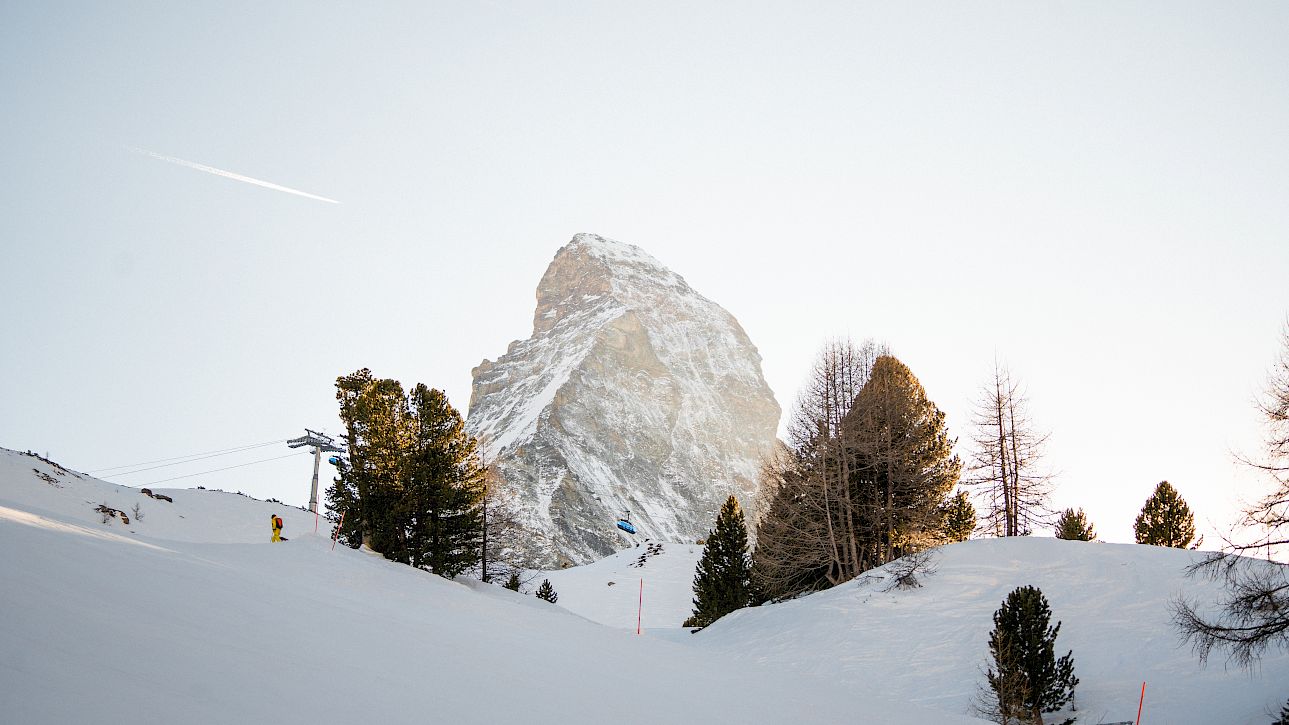
So you book a flight to Zurich, a train to Zermatt, and walk out of the station into a car-free village with the most photographed mountain on the planet staring you in the face.
And then it hits you: this is nothing like skiing in the States.
The trail map makes no sense. There are three completely separate base areas. The piste markers are colors you've never seen. People are sitting down for two-hour lunches on the mountain. And nobody seems stressed about it.
This guide is for you. Written from Hotel Zermama, a boutique ski hotel located two minutes on foot from the Sunnegga funicular, for American Ikon Pass holders who want to ski Zermatt smart, not just ski it.
What Your Ikon Pass Actually Gets You in Zermatt
Let's clear this up before anything else, because the fine print matters.
Ikon Pass (Full): 7 days of skiing in Zermatt. No blackout dates. No reservations needed. Direct to lift: your Ikon card works at the turnstile, no ticket office required.
Ikon Base Pass: 5 days in Zermatt. Blackout dates apply, typically the last week of December and select weekends in January and February (check ikonpass.com for exact dates each season).
Ikon Session Pass: Zermatt is included, but days count against your total season allowance of 2–4 days across all destinations. Choose wisely.
What's included: All Zermatt lifts, gondolas, and the Gornergrat cogwheel railway. That covers the Sunnegga–Rothorn area, the entire Gornergrat sector, and the Klein Matterhorn / Matterhorn Glacier Paradise, which is Europe's highest lift-served skiing at 3,883 meters (12,740 feet).
What's NOT included: The Italian side. Skiing across the border to Cervinia costs an additional CHF 52 per day (roughly $58). You buy it at a ticket window in Zermatt. It is worth every franc, and there will be more on that later.
Pro tip from the front desk: Your Ikon card works directly at the gates, but if you want to add the Cervinia upgrade or the SkiCare rescue insurance (CHF 5/day, and yes, you want it), you'll need to stop by a ticket office once. Do it on your first morning before hitting the slopes. The office at Sunnegga base is the least crowded.
The Three Mountains: A System, Not a Resort
Here's the thing that throws most Americans off: Zermatt isn't one ski resort. It's three distinct mountain areas, each with its own base station, its own personality, and its own access point in the village. They're connected on the mountain, but not seamlessly; you need to plan your day around which area you start from.
Think of it less like Vail (where everything connects from one base) and more like having three separate ski areas within walking distance that happen to share a lift pass.
1. Sunnegga–Rothorn: Your Home Mountain
Access: Underground funicular ("Sunnegga Express"), 2-minute walk from Hotel Zermama
Elevation range: 2,288m (Sunnegga) to 3,103m (Rothorn)
Vibe: The friendly, sun-drenched side. Best Matterhorn views. Best on-mountain restaurants. If you're staying at Zermama, this is your home mountain. The entrance to the Sunnegga tunnel is a short walk from the hotel, and once you're inside, a fast funicular shoots you up to Sunnegga station in about three minutes. From there, the ski area cascades across the Findel Valley with a range of terrain that suits everyone. Beginners head to Wolli Park just below Sunnegga (a dedicated learning zone with magic carpets and gentle slopes). Intermediates will spend happy days on the rolling reds between Blauherd and Rothorn. And the views, with the pyramid of the Matterhorn framed perfectly across the valley, are the best you'll find anywhere in the resort.
Best runs: The #14 blue from Rothorn is a beautiful warm-up cruise with the Matterhorn dead ahead. For something with more teeth, the #4 red from Rothorn via Kumme takes you into steeper, quieter terrain. And when conditions are right, the itinerary routes (numbers 16 and 17) from Rothorn offer genuinely challenging, ungroomed descents.
Lunch here: Chez Vrony at Findeln is legendary. A family-run restaurant perched on a sun terrace at 2,100m with what might be the best lamb chops in the Alps. Reservation strongly recommended. Adler Hitta, just down the trail, is equally good and a bit easier to walk into.
What Mama's team says: "Start every trip here. Get your legs, find the light, eat well. The other mountains can wait a day."
2. Gornergrat: The Panorama Machine
Access: Gornergrat Bahn cogwheel railway, departing next to Zermatt train station (10-minute walk from Zermama, or one stop on the free eBus)
Elevation range: 2,815m (Riffelberg) to 3,286m (Hohtälli) — Gornergrat summit at 3,089m
Vibe: Grand, high-alpine, less tree cover. Incredible 360° panorama from the summit. Intermediate paradise with serious expert terrain hiding in the back.
The Gornergrat railway is an experience unto itself, a red cogwheel train that climbs 33 minutes through snow-covered forests and across bridges with the Matterhorn growing larger in your window the whole way up. Non-skiers take this train just for the view, and honestly, you should ride it at least once even if you plan to ski down.
The skiing here is wide-open, high-altitude cruising. Long red runs sweep down from the summit with spectacular views of the Monte Rosa massif and the Gorner Glacier. Intermediates will be in heaven. The area between Gornergrat and Riffelberg has some lovely blue runs too, making it a solid option for mixed-ability groups.
But here's what the brochures don't tell you: the Gornergrat sector also hides some of Zermatt's most serious expert terrain. The Stockhorn and Hohtälli areas, which are accessible via cable cars from the Gornergrat side, open up steep, rocky freeride terrain and the famous (or infamous) itinerary routes that drop into the valley with serious vertical.
Best runs: The #28 and #29 reds from Gornergrat are long, uncrowded, and glorious. For beginners building confidence, the blue runs around Riffelberg are wide and forgiving. If you're an expert, get yourself to Hohtälli and look at the itinerary options, but go with a guide your first time.
Lunch here: Kulmhotel Gornergrat sits right at the summit and offers a surreal dining experience at 3,089m. The Riffelalp Resort has a more refined, sit-down option mid-mountain.
What Mama's team says: "Gornergrat on a blue-sky morning is as good as skiing gets anywhere on Earth. But if clouds roll in, you're very exposed up there, so have a Plan B."
3. Klein Matterhorn / Matterhorn Glacier Paradise: The Big One
Access: Matterhorn Express gondola from the south end of Zermatt village (15-minute walk from Zermama, or take the free eBus red line)
Elevation range: 2,583m (Schwarzsee) to 3,883m (Klein Matterhorn summit)
Vibe: High-altitude, glacier skiing, gateway to Italy. The biggest terrain in Zermatt with the most reliable snow. Feels like another planet.This is where Zermatt gets truly unique. The Klein Matterhorn station sits at 3,883 meters, making it the highest lift-served point in Europe. To put that in perspective: that's higher than every ski area summit in Colorado, and higher than the top of the Jackson Hole tram. You are skiing on an actual glacier, above the clouds, with 38 peaks over 4,000 meters visible on a clear day. The Matterhorn Glacier Ride, a modern 3S cable car, takes you up in about 9 minutes and deposits you in a world of wide, rolling glacier pistes. The snow up here is reliable well into May, and summer skiing operates on the Theodul Glacier through July and August. Below the glacier, the Schwarzsee area sits directly beneath the north face of the Matterhorn. It's often less crowded and has excellent red runs in dramatic scenery.
The Italy Connection: From the top of Klein Matterhorn, you can ski down the other side of the mountain into Cervinia, Italy. This is a bucket-list experience: you leave Switzerland, ski through a border crossing on the glacier, and descend into the Italian Aosta Valley for long, sweeping runs, cheaper mountain lunches (a full pasta and a glass of wine for a fraction of Swiss prices), and a completely different vibe. The crossing requires good weather, as wind can and does shut it down. Plan your Italy day early in your trip so you have backup options. And pay attention to the posted "last lift back to Zermatt" times. Miss it, and you're spending the night in Italy. (There are worse fates, but your luggage is still at Mama's.)
Best runs: The full top-to-bottom descent from Klein Matterhorn to Zermatt village is roughly 2,200 meters of vertical and 16 km long, making it one of the longest continuous ski runs in the Alps. On the Italian side, the runs into Cervinia are wide, fast, and incredibly satisfying for intermediate skiers.
Lunch here: Cross to Cervinia and eat at a rifugio. A full Italian lunch (pasta, espresso, maybe some grappa) costs about €20–25 compared to CHF 40–50 for a comparable meal in Zermatt.
What Mama's team says: "Italy day is the highlight of most people's trips. But check the Matterhorn app that morning. If the crossing is closed, don't waste your day waiting; head to Sunnegga or Gornergrat instead and try Italy tomorrow."
"But Is It Ski-in / Ski-out?"
Let's be honest: no. Not in the way Americans mean it.
In the US, "ski-in/ski-out" means you clip into your bindings at the back door of your hotel and glide onto a chairlift. In Zermatt, that only exists at a handful of mountain lodges like the Riffelhaus or the Kulmhotel Gornergrat, and they're up on the mountain, not in the village.
From any hotel in Zermatt village, including Zermama, you walk to a base station. The difference is how far you walk and to what.
From Zermama, the Sunnegga funicular entrance is a 2-minute walk. The ski bus stop is directly outside the front door. A rental shop is right next door. Once you step out of the funicular at the top, you're on snow and skiing within seconds.
Is it a gondola-out-the-back-door situation? No. Is it the most convenient access point to Zermatt's most versatile ski area? Yes. And honestly, the 2-minute walk through a quiet, car-free Alpine village with the Matterhorn ahead of you is not exactly a hardship. It might be the best part of your morning.
How to Plan a 5- or 7-Day Ikon Trip
Most American visitors have either 5 (Base) or 7 (Full) Ikon days to work with. Here's how we'd spend them.
The 5-Day Plan (Ikon Base)
Day 1: Sunnegga (warm-up day). Get your legs, learn the system, enjoy the views. Lunch at Chez Vrony. Don't push it, as you're jet-lagged and at 2,500m+.
Day 2: Gornergrat. Take the cogwheel railway up, ski the big panoramic reds, soak in the 360° views. This is your "wow, I'm actually in Switzerland" day.
Day 3: Klein Matterhorn + Italy. Go big. Take the glacier ride to the top, ski down to Cervinia for lunch, ski back. Start early and check the weather app first.
Day 4: Sunnegga–Rothorn (deep exploration). Now that you know the system, go find the quieter runs. Rothorn summit, the Kumme descent, the Findel Valley. This is the day you fall in love with Zermatt.
Day 5: Dealer's choice. Repeat your favorite area, or use this day for something you missed, such as a second Italy crossing, the Stockhorn expert terrain, or just a lazy morning followed by an afternoon of long runs in the sun.
The 7-Day Plan (Full Ikon) — Add:
Day 6: Full Italy day. Go deeper into the Italian side. Ski all the way down to Valtournenche (22 km from Klein Matterhorn summit). Take your time. Eat slowly. This is a relaxed day with massive mileage.
Day 7: Farewell run. Revisit your favorite spot. For most people, that's Sunnegga in morning light. End with an Aperol on the Zermama Bistro terrace, still in your ski boots, watching the Matterhorn turn pink at sunset.
Rest Day?
Take one. Seriously. A rest day isn't wasted; it's an investment. Your legs, lungs, and brain will thank you (you're skiing 1,500–2,200 meters higher than you do at home). Walk through the village, visit the Matterhorn Museum, ride the Gornergrat railway just for fun, or book a spa treatment. Zermatt is gorgeous even when you're not on skis.
What Americans Always Get Wrong
We love our US guests at Mama's. But after hosting hundreds of them, we've noticed a few recurring surprises. Here's the heads-up nobody else gives you.
Trail markings are different
Forget green/blue/black. In Europe, it's blue (easy), red (intermediate), and black (expert). But here's the kicker: Zermatt also has yellow "itinerary" routes, which are marked and avalanche-controlled but not groomed and not patrolled. These are essentially sanctioned off-piste. In the US, this would be expert-only terrain behind a gate. In Zermatt, it's just casually marked on the trail map. If you see yellow, know what you're getting into.
Lunch is a ritual, not a pit stop
In the States, mountain lunch is a grab-and-go burrito in a crowded lodge. In Zermatt, people sit down for an hour or more at a sun-drenched terrace restaurant, order a bottle of Fendant (local white wine), and take their time. Embrace this. Budget 60–90 minutes for lunch. Your afternoon skiing will be better for it.
Altitude is real
Zermatt village sits at 1,620m (5,315 ft). That's already higher than most East Coast summits. When you ski up to Klein Matterhorn at 3,883m (12,740 ft), you're significantly higher than the top of Vail (3,527m) or the summit of Telluride (3,831m). If you're coming from sea level (New York, Miami, LA), take it easy on day one. Hydrate aggressively. Go easy on the après-ski wine on your first evening. Altitude sickness is no joke at these elevations.
The safety bar comes down
If you're used to the relaxed attitude toward chair lift safety bars in the US, where half the time nobody bothers, prepare for a culture shift. In Zermatt, the bar comes down immediately. On many lifts, it's automatic. Don't get bonked on the head.
Rescue isn't included
In most US resorts, ski patrol rescue is included with your lift ticket. In Zermatt, it's not. A helicopter rescue can cost CHF 5,000+. Buy the SkiCare insurance at the ticket office (CHF 5/day). Also check whether your travel insurance covers mountain sports at altitude, since many US policies have exclusions above 3,000m.
There's no parking because there are no cars
Zermatt is completely car-free. You cannot drive here. Period. If you rented a car in Zurich, you'll leave it in Täsch (the village before Zermatt) in a multi-story parking garage, then take a short shuttle train into Zermatt. Within the village, you walk or take the free electric bus (eBus). Most Americans find this bizarre for about 12 hours and then never want to go back to a resort with cars.
Ikon Pass + European Ski Safari
One of the best reasons to use your Ikon days in Zermatt is that it's not the only European destination on the pass. With a little planning, you can build a European ski safari that would cost a fortune in lift tickets alone.
Currently on the Ikon Pass in Europe:
Zermatt (Switzerland): 7 days
Chamonix Mont-Blanc (France): 7 days
Dolomiti Superski (Italy): 7 days
Kitzbühel (Austria): 7 days
St. Moritz (Switzerland): 7 days
Ischgl (Austria): 7 days
Grandvalira (Andorra): 7 days
A classic 2-week route:
Week 1: Fly into Zurich → train to Zermatt (4–5 days) → train to St. Moritz (2 days)
Week 2: Train to Innsbruck → Kitzbühel (2 days) → train/car to Ischgl (2 days) → fly home from Innsbruck or Zurich
That's four world-class resorts, two countries, and up to 18 Ikon days, all on one pass. Switzerland's rail system makes the connections painless, and trains in Austria are equally efficient.
FAQ‘s
-
Yes. Your physical Ikon Pass card works directly at the turnstiles; no exchange or separate ticket is needed. Just tap and go.
-
Full Ikon Pass: 7 days, no blackout dates. Ikon Base Pass: 5 days with select blackout dates. Ikon Session Pass: days deducted from your total season allowance.
-
Your Ikon Pass covers the Zermatt side only. To cross into Cervinia (Italy), you'll need a daily supplement of CHF 52 (~$58), purchased at a Zermatt ticket window.
-
Not in the American sense. All hotels in the village require a walk to a base station (funicular, gondola, or railway). From Hotel Zermama, the nearest base station (Sunnegga) is a 2-minute walk.
-
It's an "itinerary route", which is marked and avalanche-controlled but not groomed and not patrolled. Treat these as expert-level off-piste. If you wouldn't ski a backcountry gate at home, don't ski yellow here.
-
Zermatt village is at 1,620m (5,315 ft). The highest skiing is at 3,883m (12,740 ft) at Klein Matterhorn, which is higher than almost any lift-served terrain in North America. Take your first day easy, drink water, and consider skipping alcohol for the first evening.
-
Yes. Unlike most US resorts, ski patrol rescue is not included with your lift ticket. SkiCare insurance is CHF 5/day and covers on-piste rescue. Check your travel insurance for helicopter evacuation coverage above 3,000m.
-
Yes, but with caveats. The beginner areas (Wolli Park at Sunnegga, Riffelberg on Gornergrat) are excellent, and the ski school is strong. However, there are no valley-level beginner runs; all learning happens at altitude, which means you'll need to download via lift to return to the village.
-
Zermatt is bigger than any single US resort, with more vertical drop, higher elevation, and the cross-border connection to Italy. The terrain suits intermediates exceptionally well. The experience is radically different: car-free village, mountain restaurant culture, European ski etiquette, and the Matterhorn as a constant companion. Most Americans we host say it's the best skiing experience of their lives, not because the skiing is harder, but because everything around it is better.
-
Late January through mid-March offers the most reliable conditions across all three mountains, plus the best chance of the Italy crossing being open. Early December can be thin on lower slopes. April and May bring spring snow and long sunny days on the glacier. And yes, you can ski in summer (June through September) on the Theodul Glacier, though it's limited terrain.
Hotel Zermama sits at Matterstrasse 23, two minutes on foot from the Sunnegga funicular, which is your fastest route onto the mountain. 29 rooms, Matterhorn views, faux-fur robes that you'll never want to take off, and the Zermama Bistro running from 7 AM to midnight. Come to Mama.
-
There's a rental shop (Flexrent) right next door to Hotel Zermama, just steps from the Sunnegga funicular entrance. Or skip the shop entirely: Mama has partnered with Cirkel Supply, so you can order your ski outfit online in advance, and it'll be waiting for you in your hotel room upon arrival. When you're done, just leave it behind, Mama takes care of sending it back.
-
Take the train directly from Zurich Airport to Zermatt, journey time is roughly 3.5 hours with one or two changes. Since Zermatt is car-free, you'll leave any rental car in Täsch and take a short shuttle train the final stretch into the village.
-
Hotel Zermama sits just two minutes on foot from the Sunnegga funicular entrance, making it one of the closest hotels in the village to Zermatt's sunniest, most beginner-and-intermediate-friendly ski area.